Wednesday, January 26, 2011

Addiction games


Abstract
            Real-time, social and online games are very popular these days. Video games are a main social issue discussed in the society. Research was done to discover the effects of game addiction on adolescents and adults but only a few mentioned the causes of these addictions and what is leading the gamers to become addicted. Game users are becoming addicted to real-time games because of the strategies used by the creators: visual immersion, psychological satisfaction and gamer responsibilities. The well-liked Farmville, which is today’s most addictive game, was used as an example to prove and explain the analysis done. The goal of this game is to build your own farm and take good care of it, which is the hardest part because it is a real-time game that force you to come back several times per day to harvest your crops. Once that the gamers are aware of these three strategies, would it make any difference with there way of playing? Would they be less controlled and addicted?

Key words: Real-time games, addiction, visual immersion, psychological satisfaction and gamer responsibilities.

Addiction games
Introduction:
Although many teens or adults that are occupied in real-time games never happen to become addicted, some are not as fortunate. One of the most popular of these games currently is Farmville; it is a free game played on one’s Facebook account. Users progress through the game by planting and harvesting crops at listed times that obligates them to come back or else they will lose their vegetation. Of course users are rewarded for their work and can decorate and plant a lot of different seeds on their land. According to Liszkiewicz, P. (2010), more than seventy-three million persons play Farmville and twenty-six million persons play it everyday (Para 3, p.2). Nowadays a lot of games are continuous in a way to get players’ curiosity to discover where the game is taking them. What is video-game addiction (n.d) statistics proves that one in ten adolescence gamers (from eight to eighteen) can be categorized as pathological gamers or obsessed to video-gaming (Para 4). Game users are becoming addicted to real-time games because of the strategies used by the creators: visual immersion, psychological satisfaction and gamer responsibilities.
Methodology:
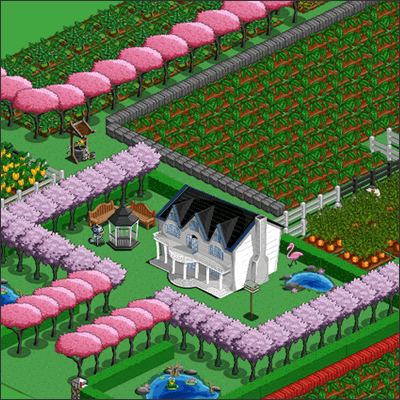
After choosing the research paper’s topic many visual and written research were done to specify the subject and get directly to the point. Three strategies were found to make the user addicted to the game and each one of them was divided into two parts. The first tactic was visual immersion; three dimensional design and lighting. The second was psychological satisfaction; awards and socializing. The last one was gamer responsibilities; routine and obligation. The game Farmville was used as example to explain and prove the methods used by the game creators to attract the player and three figures in different stages were shown to see how step-by-step the game develops and become more enthusiastic keeping easily the user’s interest.
Literature review:
Visual Immersion:
            One of the most important strategies that will make the player attached to the game is the visual immersion created by the three dimensional design, perspective and lighting. Blow, J. , Blasband, C. , Ahmad, A. and Mccool, M. (2001) mention that what is important for game creators is to convince the players that they are in a real unusual earth that is why it is important to use 3D graphics for the design to make it more close to actual life (Para 1). As Blow, J. , Blasband, C. , Ahmad, A. and Mccool, M. (2001)  say 3D accelerators have covered the way for more and more complicated geometric elements and what was beyond belief is now easily possible (Para 2). What will give the realistic look for the 3D graphics are the reflectance properties of a material or a surface. Once light is added to the object it will shine and become more close to the real-world materials especially when adding shadows. As reported by Blow, J. , Blasband, C. , Ahmad, A. and Mccool, M. (2001) computer graphics investigators have created many elaborated reflectance forms that can characterize real surfaces (Better reflectance models, Para 1).
Psychological satisfaction:
            Other than the vision immersion, the psychological satisfaction that the player will feel while playing will make him much more attracted to the game. In real-time games there is always new levels to get and to unlock new stages; the gamer will always be excited about the game. In Farmville for example, when getting to a new level the player will be rewarded with coins and will be able to unlock new seeds, decoration, buildings, animals… which will make the player more excited and constantly planning to get a better farm (figure 2). Referring to Cause and Impact of Video Games Addiction (n.d) real-time games can offer occasions for success, freedom and challenges (Para 11). Along with winning and rewards, what make these games more powerful are the socializing parts. The real-time games played online are considered social games. These kinds of games are most commonly played on social networks such as Facebook. As posted on Gaming Trend & Flash Game (2011) scores and rewards will be posted on one’s wall so the friends can see what he/she is playing and by clicking on the link they will be able to play it too (Para 1). In addition, in such games to get to higher levels the players will have to invite friends and have a specific number of neighbors. In this way the player will play with his/her friends and will be able to write comments on their game wall and send gifts to help with the game which will increase the degree of happiness while playing. Liszkiewicz P. (2010) notes that when playing online games specifically on Facebook there are many factors that remind the player of the game as the posted bonuses on their walls and the sent gifts (Para 4, p.3). Thus, the gamer can feel secure while playing real-time games. They will feel like they are the star of the game while in real-life they may not be that successful.
Gamer responsibilities:
            Besides the visual immersion and psychological satisfactions, the gamer will feel responsible of his/her game. Taking again the example of Farmville, Liszkiewicz P. (2010) claims that this game is defined by obligation, routine and responsibility (Para 6). In fact, it is a challenge to the player to remember and come back to the game in the exact recommended time or else the player will lose his/her hard works (figure 3). And, after harvesting his/her seeds he/she will plant again and wait for them to grow over and over again… the player will have to come back to protect his plants and without noticing he will be addicted to the game and will schedule his living around harvesting. As the example given by Liszkiewicz P. (2010), to plant a fourteen by fourteen terrain, it takes approximately six hundred clicks to farm and forces you to revisit in a couple of hours to do it another time (Para 4, p. 2).
Analysis:
            Playing real-time games can lead to games addiction. As we saw in the earlier paragraphs, the player will be fascinated with the visual immersion because of the 3D graphics and lighting effects. Moreover, he will feel a lot of psychological satisfaction while receiving awards and socializing during the game. Additionally, he will be concerned in the game and will believe that his responsible of his work because of his repetitive actions; routine and the obligations.
Conclusion:
In brief, the creators intentionally employ several strategies and techniques to connect players totally in the real-time game. As Dickey, M. , (2005) notes these games includes tasks while playing, sequence of events, challenges and interactive choices contained by the game, as well as communication with other players (Para 2, p.67). Once that the gamers are aware of these three strategies, would it make any difference with there way of playing? Would they be less controlled and addicted?

Figure 1: First stage of Farmville game


Figure 2: elaborating the farm


Figure 3: well organized farm

Figure Refrences
Google (n.d). Figure 1: first stage of Farmville game. Retrieved January 25, 2011.
Google (n.d). Figure 2: elaborating the farm. Retrieved January 25, 2011. From
Google (n,d). Figure 3: well organized farm. Retrieved January 25,2011. From

Refrences
Blow, J. , Blasband, C. , Ahmad, A. & Mccool, M. (2001). Achieving Real-Time
Realistic Reflectance. Retrieved January 21, 2011.
Cause and impact of video games addiction (n.d). Retrieved January 22, 2011. From
Dickey, M. (2005). Engaging design: How engagement strategies in popular computer
and video games can inform instructional design, 53, 2, 67-83. Retrieved January 21, 2011. From http://www,jstor.org/pss/30220429
Gaming trend & Flash game (2011). Retrieved January 21, 2011. From
Liszkiewicz, P. (2010). The real reason you are addicted to Farmville. Retrieved
January 21,2011. From http://www.businessinsider.com
What is video game addiction (n.d). Retrieved January 24,2011. From


Sunday, January 9, 2011

Don't BBM and drive

 While driving people are distracted and giving all their attention to the mobile phones by text messaging, talking and more commonly by using the blackberry messenger. That’s why my intervention project was against driving and using cell phones.
I intentionally named the campaign don’t BBM and drive because lately most of the people are using the blackberry service BBM when driving and causing lots of accidents because of the big distraction.
As Lebanese people the one and only way to make them stop repeating the same mistake is giving them fines.

That’s why I created a fine paper that looks like a real one (of course I changed some basic words and I added statistics about the increasing rate of car accidents happening because of the cell phones or else it will be considered a fraud) and placed them on the students cars parked near the university hoping that because of the shock they will read entirely the fine and realize that this is an awareness campaign and they will find themselves guilty and reduce the use of cell phones.
In the coming video we will see people’s reaction and how much the fines attracted people’s attention.


Everyone was surprised. A lot of people were looking and reading the fines even if it wasn’t their own cars. Some of them knew that it was an awareness campaign just by turning the fine and reading the statistics, others didn’t because they didn’t read it all. They thought that it was a real fine. And I knew from a friend that a group of people were going to the LAU administration telling them what is happening and why are they allowing the municipality to put fines on their cars while they are parking near the university. But my friend told them that all of this was just a project what it means that I really created a buzz exactly what I wanted to happen.
And of course because I felt that some of them believed the trick I was following them and telling them the truth and asking them to be careful and try to send their messages or talk to the phone before driving or when stopping their car. Everyone was excited telling me that I did a good job and that it was a very good idea “ you got me”. 


Tuesday, November 23, 2010

Guerrilla marketing

Guerrilla marketing is a form of marketing that relies on the use of original, unexpected, and unusual techniques to familiarize people with a brand or concept.
This type of marketing can appear anywhere. In normal locations like billboards, magazines, and TV ads, guerrilla marketing often requires the use of a strange or bizarre device, such as an unusually shaped billboard, a weird magazine ad, or a video advertisement that doesn't follow the normal methods.
Instead of using the advertisements to help the consumers to be familiar with a brand, a guerrilla marketer relies on craftiness and clever plans to get people interested. These campaigns tend to be very remarkable; few people can remember basic print ads for famous soft drinks, for example, but many consumers remember guerrilla marketing campaigns, which create debate or strong attention.


http://www.youtube.com/watch?v=qMOuF8oskRU

Tuesday, November 9, 2010

The relation between magic and ads

Magic is a theme, which introduces discussions of the role of advertising in modern society. Marketing is not just a method of selling goods; it is a true part of the culture of a puzzled world.
If the use of person supplies leaves the section of human need unsatisfied, the challenge is made by magic, to link this spending with human wishes to which it has no real reference. You do not only buy an object, you buy strength, attraction, success, ability to have power over your environment.
The magic unclear the real sources of general satisfaction, because their discovery would involve extreme changes in the whole common way of life.

The author devotes an entire chapter to consider the relations between advertising, alchemy, spells, genies and the Crystal ball. Magic is not a single unified referent system, but a process, a mythical means of doing things, a transformational system. Magic is a pivot around which misrepresentations may be produced; it always involves a misrepresentation of time in space or space in time. Time is magically drawn into space (for example the crystal ball: an object that contains the future, and where space is magically produced out of time by making things appear out of nowhere through the processes of alchemy and spells. And in the center of these magical processes is the subject you, the buyer and the user of the product).

Nowadays we are all users and not creators because consumer products and modern technology provide us with everything ready made removing the need for any action or effort done by us. Ads are used to the only thing that we can do, buy the product or incant its name. This minimal action created a “ magic spell” element: from a little action, we get great results. And of course that action is our buying.
Magic is the production of results disproportionate to the effort put in. Meaning that all consumer products offer magic, and all advertisements are spells. The ads assume a system of transformation where the results appear with miraculous quality. The more amazing results advertisements offer us, the more these come within the non-explanatory system of magic.

Magic fills the gap between action and result. We can see that sometimes products themselves are seen as producers, but the process of this production is always an absence since magic is instant and doesn’t work materially. The magical result of buying a product is the function of turning consumption into production. The end of the ad (to make us buy) is turned into a beginning (it initiates the miraculous events).
We are allowed to be producers only by being consumers. And thus we can then buy the product, which will produce the magic result (beauty, love…)
Our act of buying and saying the products name is thus a spell, which provides a shortcut to a larger action, performed by the product. Just like nowadays, we can see a shortcut through pressing buttons in mechanical actions and they perform a greater action.
This is how magic works; this is its promise in advertising. It gives instant results with little effort. But of course we are not in control of the results of the magic practices, the result is already determined by the magical product, and by the words we are told to use: the spell.

A87: Looking to this ad we can see a lot of objects signifying two unseen presences: there is the woman whose letter is partially revealed and the man who has sent the gift and will receive the letter. “ …the last time we met...”  and “ I would like to see you again soon” are both narrative possibilities left open for conjecture.
The woman knows what is written while we do not. But what we have in common with her is the knowledge of the magical powers of the box. It has brought the man into the room. And not only she has opened the magic box first but she has also written the letter before proceeding to the other present. The black magic box is forever unwrapped and about to be opened. It’s the presence of the other, unwrapped box that produces a movement in the ad, between what is closed and what is open.
Now magic produces effects in time and space: it transforms one thing into another (placing the man in the room). We construct the characters of the narrative and fill in the blanks of the story through magic.
The ad and the box are both things that can be known. The box can be opened when buying it, the ad can be interpreted to reveal what is absent. And this absence is both spatial and temporal, and the past and future events that are both emerged into the box. So we cut across time and space to find out the secret of the black magic box.

Tuesday, October 26, 2010

Graphic design in everyday life


In general, "media" refers to various means of communication, as radio and television, newspapers, and magazines… that reach or influence people widely. Media are the methods of communication and Graphic design is a mode of communication using visual medium.
Nowadays technology has come a lifestyle that has been bordered by graphic designs. For example, the websites placed on the Internet are all based on the graphic design. A graphic designer design the way of presenting the information to attract the audience in every new substance that comes on the web.
It does not include just the web but also the texts of the books, the simple covers, pictures, and the comic books that tell stories in complete graphic presentations; the movies we watch or the TV shows. Even the newspapers present their articles with the help of graphic designers that make layouts no matter how simple but very important to help catch the eye and augment the meaning of what you are looking at or reading.
The work of graphic designers is presented everywhere without knowing it. From the simplest of road signs to the biggest ads, all have some sort of graphic to get your attention. Graphics are one of the earliest teaching tools used for kids with shapes and colors being portrayed in schoolbooks all over the world.
Imagine a commercial with simply a voice trying to sell you a product with no graphic just a voice to describe and tell you why you need that product; of course it would not be a big seller. Or visualize the Coca-Cola brand without the red and white design or Nike without their trademark. There is a true power in graphic design, a control to move people in a way that makes them someway feel connected to a product just based on the way it looks. Some of the true artists of today are those people that are creating graphics for products and companies around the world.

Tuesday, October 19, 2010

perspective

Around the age of 25, Müller decided to assign himself completely to street painting. He traveled all over Europe, making a living with his transitory art.
Because of his foundation in traditional painting and modern communication, Müller uses a more simple and graphic language for his art. He paints over large areas of urban public life and gives them a new appearance, thus challenging the perceptions of passers-by. The observer becomes a part of the new scenery offered. Edgar Müller’s extraordinary art has been widely covered in print and digital media.


Edgar Müller needed 5 days to complete this giant picture. Together with up to five assistants he painted all day long from sunrise to set. The enormous illusion is reached by applying the anemographic technique to a huge street painting. Around 250 square meters large this picture is part of Edgar's newest project. 


He spent five days, working 12 hours a day, to create the 250 square meter image of the crevasse, which, viewed from the correct angle, appears to be 3D. He then persuaded passers-by to complete the illusion by pretending the gaping hole was real.

Playing with perspective
We can do some crazy things on a picture without even using Photoshop. We just have to play with perspective, take the right angle and shoot. Here is a nice selection of such pictures.


Sunday, October 17, 2010

Bricolage


Bricolage is the work of fitting an object and using it for a function that was not originally planned. Bricolage can be created in any art linked field varying from paintings, graphic design, 3D to fashion and also, in everyday life. In the world of Bricolage creativity is the key. Bricolage can also be described as a method of doing things the opposite to how they are intended to.
The fashion production uses bricolage like styles by integrating objects normally consumed for other functions. For example, using candy wrappers to produce handbags.


Another example of Bricolage in fashion would be from the film Zoolander. In the movie one of the main characters, Mugatu, creates a clothing line called “Derelicte”, this clothing line is based around using junk to make clothes.